1. Buddy allocation design
The buddy allocation algorithm implemented in this project is described in this blog post. It needs to be given a block to manage and its size. The algorithm’s main characteristics are:
- somewhat complex initialisation of the managed block
- simple allocation and deallocation methods due to the (conceptual) inner structure of the block achieved with the initialisation
- low memory consumption (from the block itself) for bookkeeping purposes
- allocation and deallocation in logarithmic time (in terms of the block size)
1.1. Ensuring correct alignment
One of the most important things for the proper initialisation of the block is a power of two size. Clients may pass in blocks whose size is not a power of two, however. This can be solved by logically extending the block from its left end. Thus, we’ll have to work with a logical block start and size.
As discussed in the blog post, the block can be conceptually broken into many blocks, the smallest of which are called leaves. If the block needs to be logically extended, the leaves in the extended part of the block are just logical leaves. The ones that are part of the actual block are physical leaves. The leaf size is a (power of two) constant that is chosen carefully by keeping in mind that leaves will be the smallest blocks to be allocated and will need to be able to fit two (aligned) pointers.
While reading the following paragraphs, refer to the illustration below them.
Let us denote the leaf size with L, alignof(std::max_align_t) with M and assume that M ≤ L. Let’s assume we are given a block starting at address A and let B ≥ A be the first address within the block which is aligned to M. Let d = B - A, d < M. Let k be the number of leaves fitting in the block starting at B and S = k * L be the size of the block made up from the leaf blocks. The (physical) leaf blocks are thus at addresses B + i * L, for 0 ≤ i < k. Let S’ = S + d > 0 * L, that is, S’ = k’ * L, where k’ = k + (d > 0). S’ takes into consideration the possible offset for alignment, thus potentially introducing a logical leaf.
Let N (the logical size) be the first power of two which is ≥ S’ and D = N - S’. It is not hard to prove that there is a natural number t such that D = t * L. Let C = B - (d > 0) * L and Z = C - D be the logical start of the block.
The size of the block between Z and C is D = t * L so this block is broken up into (logical) leaves with addresses Z + i * L, for 0 ≤ i < t. The size of the block between C and B (if any) is exactly L. So, starting from Z, we have n = t + k’ leaves with addresses Z + i * L, for 0 ≤ i < n. Since M and L are powers of two and M ≤ L, we know that L / M is a positive integer, that is, M “fits” exactly L / M times into L and there is no space left. Thus, since B is aligned to M, each of the leaf blocks is also aligned to M. Since each address returned by the allocator is that of a leaf, we know that the allocator always returns blocks alligned to M.

As we’ll see later, in the average case d will not be big enough to store useful information so we’ll act as if it is 0.
1.2. Bookkeeping data structures
The implementation uses one implicit data structure - the binary tree formed by splitting the (logical) block into smaller ones, and three explicit data structures:
- a sequence of free lists, one list for each level in the tree
- a bit map storing whether the non-leaf blocks in the tree are split
- a bit map storing a bit per buddy pair which holds the value is_free(buddy_A) XOR is_free(buddy_B)
The free lists are implemented to store a single pointer to the first block in the list. Their alignment requirement will thus be ≤ M and the total size required for the sequence of lists will be ≥ levels_count * pointer_size.
The bit maps are simply sequences of bytes so they can be stored at any address. The formula by which their size is computed is illustrated in the following table.
| Levels | Split map size | Free map size |
|---|---|---|
| l | 2^(l-1) - 1 | 2^(l - 1) |
| 2 | 1 | 2 |
| 3 | 3 | 4 |
| 4 | 7 | 8 |
| 5 | 15 | 16 |
Both maps are allocated 2^(l - 1) bits because the extra bit for the split map would not require an extra byte and the maps would need an exact number of bytes either way to be able to access the last bits safely.
Since the memory lost in the beginning of the physical block (due to alignment) will be 7-8 bytes on the average (for a M = 16), it would be insufficient to store the lists as a typical pointer size would be 4 or 8 bytes.
The 8 bytes could be split into 2 groups of 4 bytes and given to the bit maps. Each bit map would have room for at most 32 bits. With half a bit per block, this means the allocator could have at most 64 blocks so 32 leaves, giving the total size of 4KB for a leaf size of 128B. So if we need to manage more than 4KB, this won’t fit the two bitmaps either. Since the allocator works well for big allocations, the total size is expected to be much more than that. Thus, this memory will be wasted.
The memory lost at the end of the physical block (because it does not fit a whole leaf) will be about 63-64 bytes on average (for a leaf size of 128B). With 64 bytes, we could fit 8 pointers for the free lists at the end of the block (on 64-bit platforms). As the address is aligned to M, they might actually fit in there. But 8 lists means 8 levels so the leaves will be 2^7 = 128. This gives us a total size of at most 16KB which is not that much. The lists should better be stored at the start of the (aligned) physical block.
We could split the 64 bytes into two groups of 32 bytes each and give them to the bit maps. This means each bit map would have 256 bits, so we could have at most 256 leaves. This gives us a total size of at most 32KB. So for blocks with size ≤ 32KB, the two bit maps could be stored in this memory. Additionally, for a small number of levels (say less than 10), the bit maps would require less memory than the lists, so they could fit in less memory than the average 64 bytes. The benefits of storing the bit maps in this memory is that it won’t be wasted and the two maps could fit into a single cache line (as the typical size is 64 bytes).
And since the bit maps have no issues with alignment, we could fit them right after the lists. This means we could try to store them after the last leaf, and if we can’t, we could fall back to storing them after the lists. Separating the bit maps so that at least one of them is stored at the end of the block would probably complicate things too much.
The resulting layout of the bookkeeping data structures is illustrated in the following image. Of course, the bit maps are stored in exactly one of the places in the illustration.

1.3. Initialising the data structures
The memory in which the bookkeeping data structures are stored is now known but how are they initialised?
Initially, the lists are empty, all bits in the split map are down and all bits in the free map except the one for the block with index 0 are down. Remember that this is the “root” block and thus has no buddy so its bit stores the value is_free(block).
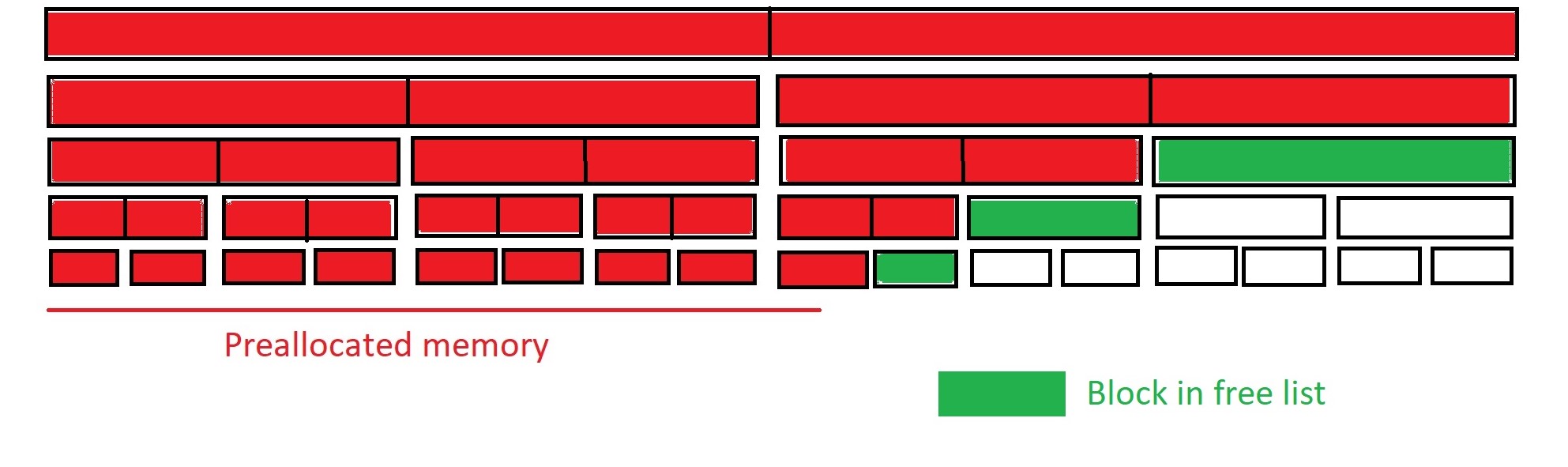
Then, we compute the total size of the memory to be preallocated. That is, the memory formed by the logical leaves plus the wasted memory for alignment and the memory needed to store the lists and potentially bit maps. The allocator will be initialised as though this memory was allocated in leaves and it will not be freed.
This process is pretty simple. First, the leaves are allocated by flipping their free bits accordingly. Then, their parent blocks are allocated in a similar way but are also marked as split. Finally, the free blocks from the lower level are inserted into the corresponding free list. This is then repeated for the parents’ parents and so on, as illustrated below.


1.4. Inserting blocks into a list
Remember that each address of a block in the allocator is aligned to M. The implementation assumes that std::uintptr_t is a built-in type so its alignment requirement is ≤ M. Then, it can be placed at the start of any of the blocks. So even if M is 64, for a leaf size of 128, we would be able to split the leaf blocks in two and store an std::uintptr_t in each half as std::uintptr_t will surely fit into 64 bytes.
Because std::uintptr_t is assumed to be a built-in type, it is also read from (written to) raw memory directly.
1.5. Time and space complexity
For time complexity let’s assume the managed block has size n and N is the first power of two ≥ n. The algorithm’s initialisation takes time O(N) while allocation and deallocation take time O(logN).
In terms of space complexity, we are interested in what percentage of the managed block is used for bookkeeping purposes. Lets assume our block is aligned to M and its size is S, that is, we’ll assume the managed block is already aligned and its size is a multiple of the leaf size. If that is not the case, the percentage will be just a bit smaller.
Let’s also assume that the free list size (in bytes) is LS. We compute the total size TS to be the first power of two ≥ S, the levels count LC = log2(TS / LEAF_SIZE) + 1, where LEAF_SIZE = 128. As the lists are placed in the beginning, the size required for them is LsS = LC * LS. The size of a bit map is BMS = size_in_bytes(2^(LC - 1)). We’ll assume the bit maps are stored right after the lists and not in the “lost” memory after the last physical leaf as the percentage would be even smaller otherwise.
Since we place the maps right after the lists, the required size for both maps is BMsS = 2 * BMS. The preallocated size is then PS = LsS + BMsS. We are then interested in:
- whether PS < S
- LC
- LsS
- BMsS
- PS
- PS as percentage of S
- PS as percentage of TS
The actual size must be at least LEAF_SIZE (otherwise there won’t be anything to allocate) so we start our measurement from there. As at least two levels are required for proper initialisation, this won’t work, but we could start with 129 which will give us two logical leaves and still a single physical one where to store the data structures. Each size < 256 would give us two logical leaves which we already tried to fit into one physical leaf. That’s why we can then measure for 256. We continue for each multiple of LEAF_SIZE.
The following table shows the results for LS = 8.
| Size | Fits | Levels | Lists size | Maps size | Preallocated size | % of size | % of logical size |
|---|---|---|---|---|---|---|---|
| 128 | False | NA | NA | NA | NA | NA | NA |
| 129 | True | 2 | 16 | 2 | 18 | 13.95 | 7.03 |
| 256 | True | 2 | 16 | 2 | 18 | 7.03 | 7.03 |
| 384 | True | 3 | 24 | 2 | 26 | 6.77 | 5.07 |
| 512 | True | 3 | 24 | 2 | 26 | 5.07 | 5.07 |
| 640 | True | 4 | 32 | 2 | 34 | 5.31 | 3.32 |
| 768 | True | 4 | 32 | 2 | 34 | 4.42 | 3.32 |
| 896 | True | 4 | 32 | 2 | 34 | 3.79 | 3.32 |
| 1024 | True | 4 | 32 | 2 | 34 | 3.32 | 3.32 |
| 1152 | True | 5 | 40 | 4 | 44 | 3.81 | 2.14 |
| 1280 | True | 5 | 40 | 4 | 44 | 3.43 | 2.14 |
| 1408 | True | 5 | 40 | 4 | 44 | 3.12 | 2.14 |
| 1536 | True | 5 | 40 | 4 | 44 | 2.86 | 2.14 |
| 1664 | True | 5 | 40 | 4 | 44 | 2.64 | 2.14 |
| 1792 | True | 5 | 40 | 4 | 44 | 2.45 | 2.14 |
| 1920 | True | 5 | 40 | 4 | 44 | 2.29 | 2.14 |
| 2048 | True | 5 | 40 | 4 | 44 | 2.14 | 2.14 |
| 2176 | True | 6 | 48 | 8 | 56 | 2.57 | 1.36 |
| 2304 | True | 6 | 48 | 8 | 56 | 2.43 | 1.36 |
| 2432 | True | 6 | 48 | 8 | 56 | 2.30 | 1.36 |
| 2560 | True | 6 | 48 | 8 | 56 | 2.1875 | 1.36 |
| 2688 | True | 6 | 48 | 8 | 56 | 2.08 | 1.36 |
| 2816 | True | 6 | 48 | 8 | 56 | 1.988 | 1.36 |
| 2944 | True | 6 | 48 | 8 | 56 | 1.90 | 1.36 |
| 3072 | True | 6 | 48 | 8 | 56 | 1.82 | 1.36 |
| 3200 | True | 6 | 48 | 8 | 56 | 1.75 | 1.36 |
| 3328 | True | 6 | 48 | 8 | 56 | 1.68 | 1.36 |
| 3456 | True | 6 | 48 | 8 | 56 | 1.62 | 1.36 |
| 3584 | True | 6 | 48 | 8 | 56 | 1.56 | 1.36 |
| 3712 | True | 6 | 48 | 8 | 56 | 1.50 | 1.36 |
| 3840 | True | 6 | 48 | 8 | 56 | 1.45 | 1.36 |
| 3968 | True | 6 | 48 | 8 | 56 | 1.41 | 1.36 |
| 4096 | True | 6 | 48 | 8 | 56 | 1.36 | 1.36 |
For LS = 16:
| Size | Fits | Levels | Lists size | Maps size | Preallocated size | % of size | % of logical size |
|---|---|---|---|---|---|---|---|
| 128 | False | NA | NA | NA | NA | NA | NA |
| 129 | True | 2 | 32 | 2 | 34 | 26.35 | 13.28 |
| 256 | True | 2 | 32 | 2 | 34 | 13.28 | 13.28 |
| 384 | True | 3 | 48 | 2 | 50 | 13.02 | 9.76 |
| 512 | True | 3 | 48 | 2 | 50 | 9.765 | 9.76 |
| 640 | True | 4 | 64 | 2 | 66 | 10.31 | 6.44 |
| 768 | True | 4 | 64 | 2 | 66 | 8.593 | 6.44 |
| 896 | True | 4 | 64 | 2 | 66 | 7.366 | 6.44 |
| 1024 | True | 4 | 64 | 2 | 66 | 6.445 | 6.44 |
| 1152 | True | 5 | 80 | 4 | 84 | 7.291 | 4.10 |
| 1280 | True | 5 | 80 | 4 | 84 | 6.562 | 4.10 |
| 1408 | True | 5 | 80 | 4 | 84 | 5.965 | 4.10 |
| 1536 | True | 5 | 80 | 4 | 84 | 5.468 | 4.10 |
| 1664 | True | 5 | 80 | 4 | 84 | 5.048 | 4.10 |
| 1792 | True | 5 | 80 | 4 | 84 | 4.687 | 4.10 |
| 1920 | True | 5 | 80 | 4 | 84 | 4.375 | 4.10 |
| 2048 | True | 5 | 80 | 4 | 84 | 4.101 | 4.10 |
| 2176 | True | 6 | 96 | 8 | 104 | 4.779 | 2.53 |
| 2304 | True | 6 | 96 | 8 | 104 | 4.513 | 2.53 |
| 2432 | True | 6 | 96 | 8 | 104 | 4.276 | 2.53 |
| 2560 | True | 6 | 96 | 8 | 104 | 4.062 | 2.53 |
| 2688 | True | 6 | 96 | 8 | 104 | 3.869 | 2.53 |
| 2816 | True | 6 | 96 | 8 | 104 | 3.693 | 2.53 |
| 2944 | True | 6 | 96 | 8 | 104 | 3.532 | 2.53 |
| 3072 | True | 6 | 96 | 8 | 104 | 3.385 | 2.53 |
| 3200 | True | 6 | 96 | 8 | 104 | 3.25 | 2.53 |
| 3328 | True | 6 | 96 | 8 | 104 | 3.125 | 2.53 |
| 3456 | True | 6 | 96 | 8 | 104 | 3.009 | 2.53 |
| 3584 | True | 6 | 96 | 8 | 104 | 2.901 | 2.53 |
| 3712 | True | 6 | 96 | 8 | 104 | 2.801 | 2.53 |
| 3840 | True | 6 | 96 | 8 | 104 | 2.708 | 2.53 |
| 3968 | True | 6 | 96 | 8 | 104 | 2.620 | 2.53 |
| 4096 | True | 6 | 96 | 8 | 104 | 2.539 | 2.53 |
This tells us that if the block to be managed has size > LEAF_SIZE, the initialisation will complete. Note, however, that we assumed the block was already aligned. More importantly, we only consider the part of the block that fits physical leaves. Thus, we would need blocks whose size is ≥ 2 * LEAF_SIZE after being aligned to M.
It also tells us that for big enough blocks, say bigger than 1KB, the bookkeeping requires no more than 5-6% of the memory. For very large blocks, the figure becomes insignificantly small - around 1-2%.